
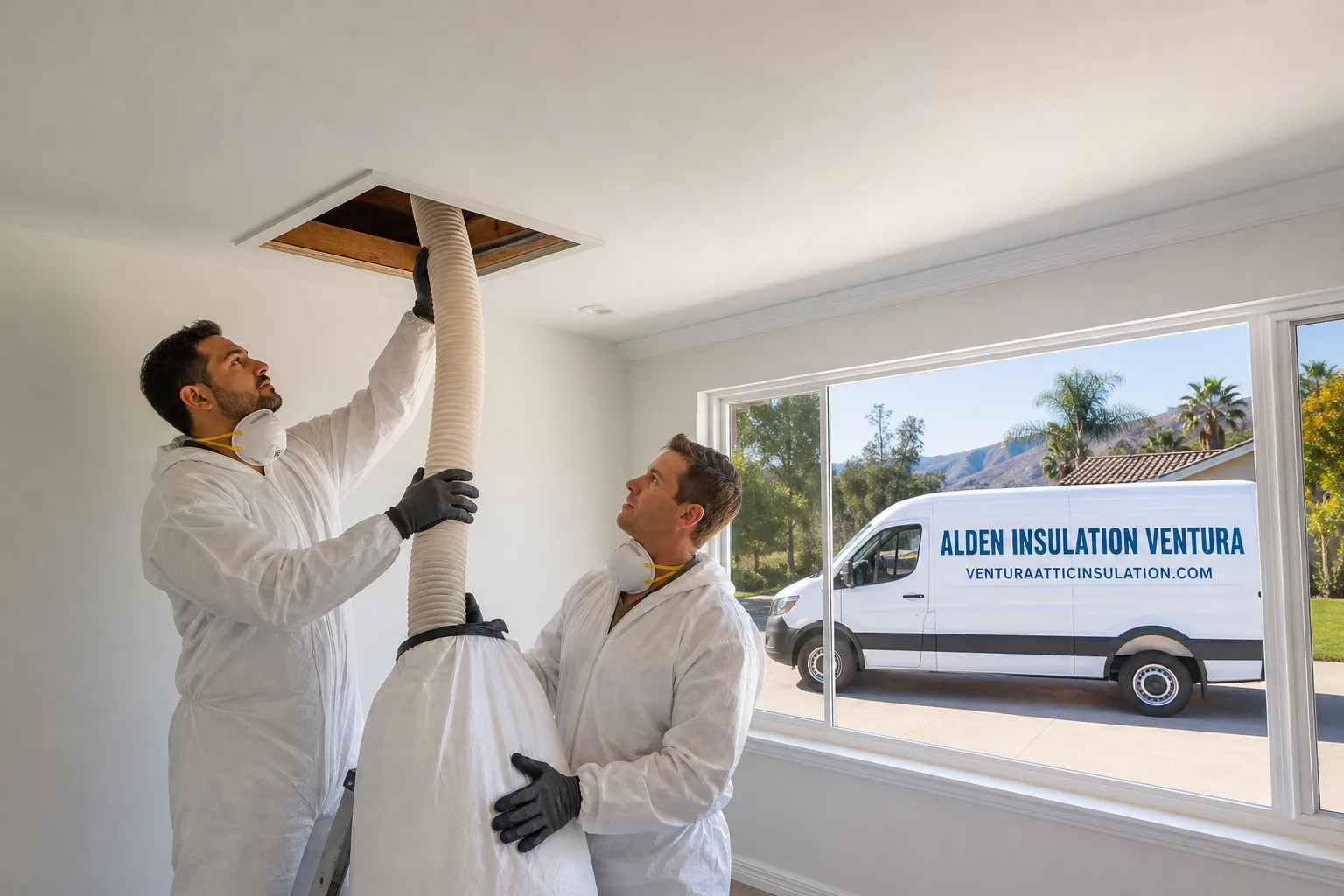
Fast, Reliable Insulation Removal Across Port Hueneme
Insulation removal in Port Hueneme runs $1.50 to $3.25 per square foot for most residential jobs, with a typical 1,200-square-foot attic landing between $1,800 and $3,900. We dispatch crews to Port Hueneme same-day in most cases, and we answer the phone with a live person 24/7 at (341) 895-7513. Coastal conditions here do not just age insulation. They actively rot it, corrode its supports, and turn fiberglass into a damp sponge. That is the job we show up for: cutting out the material that has failed, cleaning what is left behind, and getting your attic dry and tight again.
We know the streets south of Hueneme Road, the 1950s and 1960s tracts off Ventura Road, and the mobile home parks near the harbor. Local knowledge matters when you are pulling insulation that has been soaking in fog and salt air for thirty years. You will get a written price before we start, a uniformed and background-checked technician, and a written guarantee good for 365 days.
Key takeaways:
- Removal averages $1.50 – $3.25 per square foot in Port Hueneme.
- The marine layer corrodes insulation fasteners and saturates batts faster than inland homes.
- Moisture assessment comes first, always, before any material comes out.
- Written price, written 365-Day Done Right Promise, live-answer phone line.
Why Alden Insulation Ventura Is Port Hueneme’s Preferred Insulation Removal Company
Alden Insulation Ventura is part of the Garrison Partners family, established 2002. Every job here runs under The Garrison Standard: a written price before work begins, a background-checked technician in uniform, and a written guarantee in your hand. That is the discipline Port Hueneme homeowners ask for after getting burned by contractors who no-show or move the price at the door.
We operate under The Garrison Code, which is plain about what counts as done right. If it fails within 365 days, we return at no charge. That promise is in writing. You will not get a vague half-day arrival window either. We commit to a scheduled time and hit it. Our Insulation Removal crews work this coast year-round, so the salt-air failures we see in Port Hueneme are not new to us. They are the standard call.
When you call (341) 895-7513, a live person answers. Not a voicemail, not an answering service script. You can tell us the address off Hueneme Road or down by the harbor, describe what you are smelling and seeing, and get a straight answer about what removal will take.
Moldy Insulation in Port Hueneme
Moldy insulation in Port Hueneme is a moisture problem first and a disposal problem second. The marine layer that sits over this city from late spring through early fall pushes fog into attics through unsealed can lights, vent boots, and soffit gaps. Fiberglass and rockwool soak it up, hold it against the drywall, and within two winter seasons you have the start of a mold bloom. What the job involves here: we contain the affected area with negative air pressure, bag the contaminated batts, HEPA-vacuum the joist bays, and treat the framing before anything new goes in. A typical Port Hueneme attic mold removal runs $2,200 to $4,800 depending on square footage and how far the contamination has spread.
Containment and Disposal
Removing moldy material is not a tear-out-and-run job. Spores move. Our crew seals off the attic access, runs a HEPA-filtered negative air machine, and bags every batt inside the containment zone before it comes down through your house. That is the difference between removing mold and relocating it into your hallway. For older Port Hueneme homes where the insulation has been in place since the Johnson administration, the dust load alone demands this method.
Fog-Driven Saturation
Marine fog does not soak insulation from above. It condenses on the underside of roof sheathing and drips down into the batts, especially where the vapor barrier has torn or the fasteners have let go. In homes within half a mile of the beach, we regularly find the top two inches of fiberglass saturated while the bottom looks dry. That is a classic Port Hueneme signature, and it tells us where the air sealing failed.
Insulation Replacement in Port Hueneme
Insulation replacement in Port Hueneme most often means pulling out fiberglass or rockwool that has been destroyed by salt-laced moisture and dropping in closed-cell foam or a properly faced batt system with real vapor control. Replacement runs $2.50 to $4.75 per square foot installed here, edging higher when we are retrofitting exterior walls near the beach because those applications require careful air sealing around every penetration. The right time to replace is the moment the old material stops doing its job: sagging batts, damp patches on the ceiling, a musty smell that comes and goes with the fog, or heating bills that climb while the house feels colder than the thermostat says.
Closed-Cell for Coastal Walls
Homes south of Hueneme Road take the worst of the onshore flow. Salt spray rides the breeze and settles on everything metal: box nails, staples, wire supports, drywall screws. Closed-cell foam does two jobs at once in that environment. It insulates, and it acts as a bonded vapor barrier that stops salt-laden air from reaching the framing in the first place. For exterior wall retrofits on older Port Hueneme ranches, this is the material we recommend most often, and we install Rockwool, Owens Corning, and Knauf products depending on the assembly.
Attic Rebuilds in 1950s and 1960s Homes
The tract homes built around Port Hueneme in the 1950s through 1970s often left the factory with R-11 batts laid shallow and loose. Sixty years of fog intrusion has not improved them. When we replace attic insulation in those houses, we air-seal the top plates first, then blow or batt to R-38 or better, which is the right level for a coastal climate where moisture control matters more than extreme R-value. The job includes removing the old material completely, because leaving compromised insulation under new insulation just locks the problem in place.
Trusted Brands We Service in Port Hueneme
We install and remove insulation using products from Owens Corning, Johns Manville, Knauf, Rockwool, and five other industry-respected brands. You can look up every material we quote before you say yes, because we will name it on the written estimate. For Port Hueneme specifically, we carry closed-cell foam kits, vapor-barrier retrofit materials, and galvanized support systems suited to salt-air exposure. When a job needs Owens Corning batts or Port Hueneme Blown In Insulation from Knauf, we have local stock staged for Port Hueneme work, which keeps turnaround short when the fog has already done its damage.
Common Insulation Removal Problems We See in Port Hueneme Homes
- Corroded vapor-barrier staples and wire supports. Salt spray north of the harbor eats steel fasteners fast. The staples rust through, the wire lets go, and batts slump away from the top plate, leaving a four-inch gap where cold marine air pours in. We see this in nearly every removal south of Hueneme Road.
- Fog-saturated fiberglass around can lights. Unsealed recessed lights act like fog funnels. Moist marine air pushes through the can, saturates the surrounding insulation, and feeds mold growth in under two winters. Removal here always includes air-sealing those penetrations before new material goes in.
- Damp rockwool in mobile home belly boards. Older mobile homes near the harbor collect condensation between the belly board and floor insulation. Rockwool becomes a dense, damp mat that holds water against floor joists and accelerates rust. We remove the ruined insulation, dry the cavity, and replace it with a vapor-resistant assembly that will not repeat the cycle.
- Corrosion on exterior wall insulation facings. Homes within sight of Port Hueneme Beach accumulate a fine salt film on kraft-faced batts inside exterior walls. The facing degrades and the staples rust, and eventually the batting slumps inside the stud cavity. A coastal home needs closed-cell foam or a full vapor-barrier retrofit, not just new batts.
Pricing for Insulation Removal in Port Hueneme, CA
A typical insulation removal job in Port Hueneme runs $1.50 to $3.25 per square foot for standard attic material. A 1,200-square-foot attic lands between $1,800 and $3,900. Mold containment adds cost: expect $2,200 to $4,800 when full negative-air setup and HEPA cleaning are required. Mobile home underbelly removal runs $1,100 to $2,600 for a single-wide, pushed higher by access difficulty and how much metal fastening has rusted through. A full attic removal plus replacement in a Port Hueneme tract home typically falls between $4,500 and $8,200. We give you a written price before any tool comes off the truck, and it does not move at the invoice. Call (341) 895-7513 for a free estimate. The person who answers can price your square footage over the phone.
We Also Serve Cities Near Port Hueneme
Our crews handle insulation removal throughout western Ventura County. Along with Port Hueneme, we serve Oxnard, Camarillo, Somis, and Ventura. If you are just over the city line, call us anyway. The same written pricing and 365-Day Done Right Promise applies across the whole service area.
Serving Port Hueneme, CA - Our Local Coverage Area
We’re based in the Port Hueneme area and know this community well. Use the map below to see our service coverage - if you’re nearby, we can almost certainly help.
FAQs About Insulation Removal in Port Hueneme
Look for brown or rust-colored staining on the paper facing of your insulation batts, sagging material that has pulled away from the top plate, or a musty odor that gets stronger on foggy mornings. These are signs salt-laden condensation has corroded the fasteners and saturated the material. Call (341) 895-7513 and we will inspect it and give you a written price for removal if it has failed.
Yes. We use negative air pressure and full containment: the work area is sealed, air is filtered through a HEPA unit, and every contaminated batt is bagged inside the containment before it moves through the home. Mobile home cavities are tight, and doing this correctly takes time, but cutting corners just spreads spores into your living space.
Yes, and it is the material we recommend most often for homes near the beach. Closed-cell foam bonds to the sheathing and framing, forming a vapor barrier that keeps salt-laden air from reaching metal fasteners. It is not a paint-on coating. It is an insulating layer that also stops the airflow. For coastal Port Hueneme homes, that dual function is the difference between a wall that lasts and one that rusts from the inside.
Every two to three years is reasonable for a home that close to the surf. Salt spray and marine fog work faster than most homeowners expect. We can inspect for fastener corrosion, facing degradation, and moisture intrusion, and tell you honestly whether removal is needed now or can wait. An inspection call is free.
For most of those homes, we recommend air sealing the top plates and penetrations first, then installing blown-in fiberglass or batts to R-38 or better with a proper vapor consideration. In the crawlspace and exterior walls near the harbor, closed-cell foam is the stronger choice because it directly resists salt-air intrusion. Call (341) 895-7513 and we will give you a written recommendation with named brands and a fixed price.
A Coastal Failure Pattern We Know by Heart
Port Hueneme’s marine layer does something most cities never experience. South of Hueneme Road, the fog arrives off the Channel and hangs for weeks at a time. The salt in that air lands on every exposed surface, and insulation catches it silently. The failure pattern is consistent: vapor-barrier staples rust first, then wire supports, then the facing on the batts degrades and the whole mat sags off the top plate. Once that happens, the attic stops being an insulated envelope and becomes a moisture farm. Our crew pulled moldy fiberglass batts from a 1960s ranch near Hueneme Road where the paper facing had wicked salt-laden condensation, corroding the drywall nails until the batts slumped and left a chilly bedroom wall. We used an Owens Corning vapor-barrier retrofit and closed-cell foam around the wall plates to stop the fog-driven moisture cycle. That is not a worst-case story. It is a standard Port Hueneme removal call four or five times a month during fog season.
What the big national insulation pages miss is this: Port Hueneme is not a hot-dry attic problem and it is not a freeze-thaw problem. It is a salt-and-fog corrosion problem. Moisture-intrusion assessment comes before anything else on our jobs, because there is no point installing new insulation in a house that is still breathing salt air through unsealed can lights, rotted soffit vents, and corroded top plate fasteners. We find the intrusion path, stop it, then remove the ruined material and replace it properly. That sequence is the whole job.
One more example from the field. In the older mobile home parks down by the harbor, condensation collects between the belly board and floor insulation. The rockwool soaks up the moisture and turns into a heavy, damp mat sitting directly on floor joists. Over time, the joists rust where the wet material touches them. Most removal calls in those parks start as a soft-floor complaint and turn into a full insulation removal and drying job. We see it constantly. The right fix is removal, cavity drying, and a vapor-resistant underbelly assembly that will not feed the same corrosion in another ten years.
When you call Alden Insulation Ventura for Insulation Removal in Port Hueneme, you get a crew that has already worked this exact failure pattern dozens of times. Written price first. Live person on the phone at (341) 895-7513. Background-checked technicians in uniform, and a written 365-Day Done Right Promise on every job. If it fails within that year, the return visit is free. That is The Garrison Standard, and it is not a slogan. It is the way we have run this operation since 2002.
Written by Bryce Holloway, Owner at Alden Insulation Ventura, serving Port Hueneme and western Ventura County with insulation removal, replacement, and moisture-intrusion correction.