
GreenFiber Insulation Removal in Ventura: What to Know First
GreenFiber insulation removal in Ventura typically runs $1,200 to $4,800 depending on attic size, contamination level, and whether you’re dealing with the brand’s loose-fill cellulose or its dense-pack wall product. We complete most residential removals in one day, with the attic left clean enough to store Christmas decorations the same evening. This page is for Ventura homeowners with GreenFiber insulation that’s been water-damaged, pest-soiled, or simply underperforming. If you already know you need it out, call (341) 895-7513 and we’ll give you a written price before anything gets unplugged.
We’re Alden Insulation Ventura, and as an independent GreenFiber service provider, we see this brand in attics across the 805 more than any other single product. That matters because GreenFiber fails in predictable ways, and knowing those patterns means we quote accurately and remove it without tearing up your ceilings or leaving half the material behind. We’re part of the Garrison Partners family, established 2002, and every GreenFiber removal we do carries the 365-Day Done Right Promise in writing. A live person answers our phone twenty-four hours a day, seven days a week.
Key Takeaways:
- Most GreenFiber removals in Ventura finish within one business day.
- Written price before work starts, no exceptions under The Garrison Standard.
- 365-Day Done Right Promise backs every removal job.
- Background-checked, uniformed technicians arrive inside the window we promise.
- We also work with seven other major insulation brands, including Reflectix.
How GreenFiber Products Fail – and How We Fix Them
GreenFiber builds cellulose insulation from recycled newsprint treated with borates. It’s a legitimate product when dry and properly installed. But Ventura’s coastal moisture, older home stock, and the occasional roof leak create failure patterns we’ve catalogued over two decades of pulling this material out. Here’s what we see most often and what we do about it.
- Sanctuary loose-fill settling in older Ventura attics. GreenFiber Sanctuary is the brand’s most common blown-in line in this area, and in homes near Midtown and the Westside neighborhood, we regularly find it settled from R-38 to R-19 within ten years. Cellulose settles more than fiberglass, and GreenFiber’s own coverage charts assume ideal installation conditions. The fix is full removal and a re-blow with a product matched to your attic’s actual depth and venting, not a top-off that buries the problem.
- Water saturation from coastal condensation and roof leaks. Cellulose absorbs water like a sponge. In Ventura homes within two miles of the coast, morning marine layer combined with inadequate attic ventilation means GreenFiber often tests damp even without a roof failure. Once wet, the borate fire-retardant leaches out, the material mats down, and its R-value effectively collapses. We remove it completely because you can’t dry loose-fill cellulose in place; it needs to come out, the attic needs to be dried and inspected, and new material goes in only after the moisture source is addressed.
- Pest contamination in GreenFiber Corsspond and wall applications. Rodents and possums love nesting in cellulose. GreenFiber’s Corsspond line, used in some Ventura wall retrofits, creates tunnels and nests that hold urine and droppings far longer than fiberglass would. This isn’t just an odor issue; it’s a health issue. Our techs suit up, remove the contaminated material, sanitize the framing, and re-insulate. We handle the full job, including the disposal, so you don’t have to bag rodent-soiled cellulose yourself.
- Poor initial installation leaving gaps and thin coverage. Some Ventura homes got GreenFiber blown in during the 2008-2012 wave of energy-retrofit programs, where speed counted more than coverage. We find attics where installers skipped corners above the garage or around bathroom fans, leaving cold spots and condensation. Full removal lets us air-seal those bypasses properly and re-blow at a verified depth. The problem isn’t the GreenFiber itself; it’s that no one checked the coverage before cashing the rebate.
- Mold growth on GreenFiber in unventilated attics. When GreenFiber sits in a tightly sealed attic without ridge vents or soffit airflow, the trapped moisture breeds mold on the cellulose fibers. We’ve pulled material from attics east of Victoria Avenue where the top layer looked fine but the bottom six inches were black and matted. Once mold gets into loose-fill cellulose, removal is the only responsible fix. We contain the work area, vacuum everything out with a commercial HEPA-filtered machine, and treat the sheathing before new insulation goes in.
Our GreenFiber Insulation Removal Process
Every GreenFiber removal follows the same disciplined sequence. No shortcuts, no “while we’re in there” surprises. We measure the house, match the material, do the job right the first time.
- 1
Call and estimate. You call (341) 895-7513. A live person answers. We schedule a walkthrough, and Bryce or one of our lead techs inspects the attic, checks the GreenFiber’s condition, and measures square footage and depth. You get a written price before we leave, and that number is what you pay at the end. No revision at the door.
- 2
Site preparation. On removal day, our uniformed crew lays protective floor covering from the entry to the attic access, sets up dust containment, and positions the HEPA-filtered vacuum truck. Your belongings get covered, not just moved. We tell you exactly what will and won’t be disturbed.
- 3
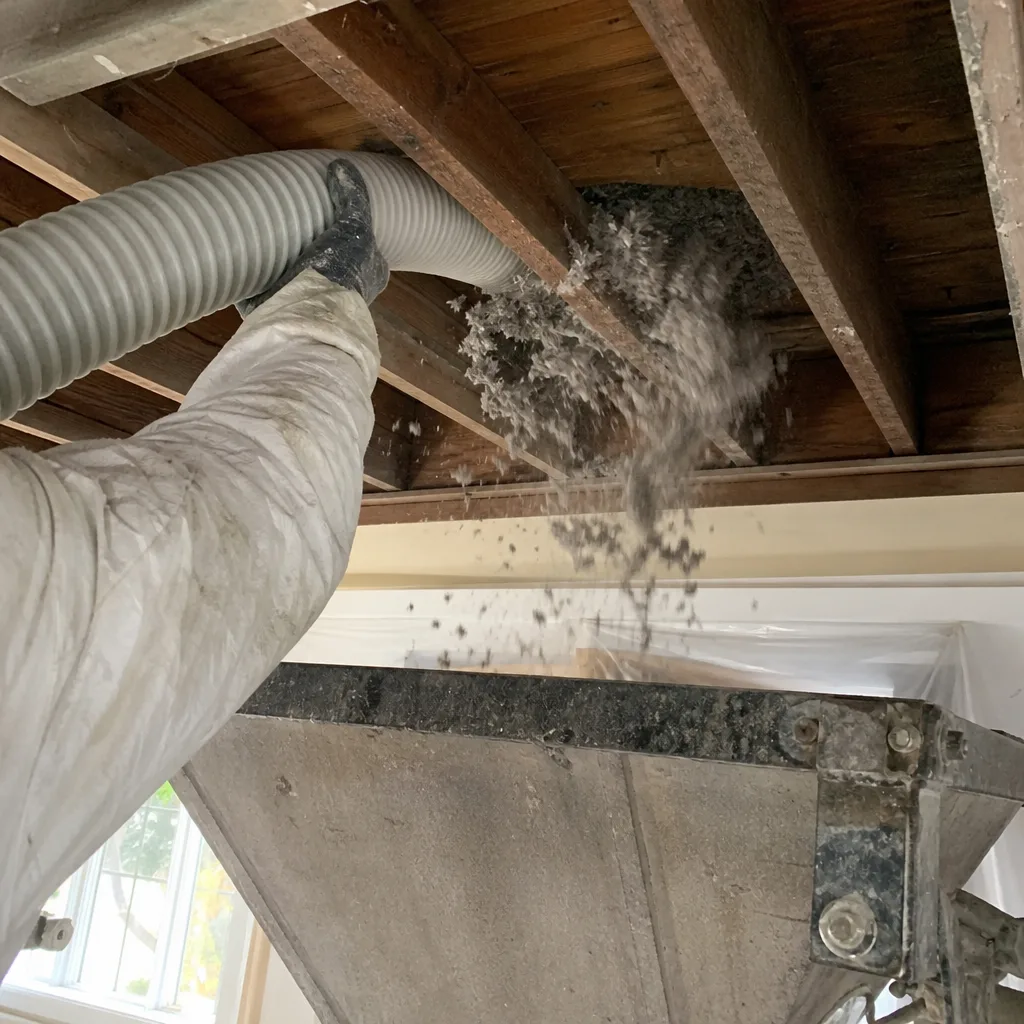
GreenFiber removal. We vacuum the attic using commercial equipment that pulls the cellulose into sealed bags outside the house. This isn’t a shop vac from a hardware store; it’s a truck-mounted unit designed for full attic extraction. Loose-fill comes out first, then dense-pack wall cavities if the job includes them.
- 4
Inspection and air sealing. With the attic empty, we inspect the decking for moisture damage, pest residue, and mold. We air-seal top plates, can-light housings, and any bypasses that were hidden under the old GreenFiber. This is where real energy savings come from, and it’s the step most removal crews skip because it takes time.
- 5
Re-insulation. We install your replacement material. If you want to stay with cellulose, we’ll quote you GreenFiber again. We’ll also show you Owens Corning, Johns Manville, Knauf, Rockwool, CertainTeed, Icynene, Demilec, and Reflectix options, with the honest differences in price and long-term performance. You decide before we start, not after.
- 6
Test and guarantee. We verify installed depth with a calibrated depth gauge, check that baffles and vents are clear, and walk you through the finished attic if you want to see it. Every job carries the 365-Day Done Right Promise in writing. If it’s not done right, we make it right at no charge within a full year.
What GreenFiber Insulation Removal Costs in Ventura
Most attic insulation removal and re-installation projects in Ventura run between $1,200 and $4,800 depending on square footage, current R-value, and contamination level. The honest variables are attic size, access difficulty, and what we find underneath: a clean removal on a 1,200-square-foot attic with loose GreenFiber starts around $1,500, while a 2,500-square-foot attic loaded with rodent-contaminated Corsspond wall cavities can run toward $8,000 with framing sanitization included.
- Loose-fill GreenFiber removal only: Usually $0.75 to $1.50 per square foot, depending on depth and contamination.
- Removal of dense-pack wall insulation: Higher, because we open and patch wall access points; most Ventura dense-pack removals run $2,000 to $4,500.
- Air sealing before re-insulation: $800 to $2,500 depending on how much wiring, fan housing, and top-plate work the attic has. This is a separate line item and worth every dollar.
- New insulation (all brands, including GreenFiber): $1,800 to $5,000 installed for an average attic, depending on R-value target and material. We install six different types and tell you which one makes sense for your house.
Call (341) 895-7513 for a written quote. Estimates are free, and the number we hand you is the number on the invoice.
Why Ventura Homeowners Call Alden Insulation Ventura for GreenFiber Work
We’re not the only insulation company in Ventura, and we’re not the cheapest. We’re the one that gives you a written price before work starts, shows up with background-checked techs in uniform inside the scheduled window, and hands you a written guarantee for a full 365 days. The Garrison Standard isn’t a slogan; it’s how we’ve operated since 2002 as part of the Garrison Partners family. Our crews have pulled GreenFiber out of attics from the Avenues to the East End, and we know this material’s failure modes better than most manufacturers will admit. When we quote a GreenFiber removal, we don’t guess. We measure the house, match the material, and do the job right the first time. We also service and install seven other brands including Reflectix, so we’re not trying to sell you the same thing we just pulled out unless it genuinely fits your attic and your budget. We live here, we work here, and our reputation is tied to every bag of cellulose we haul out of a Ventura attic.
FAQs
Does removing GreenFiber insulation void my GreenFiber warranty?
It can. GreenFiber’s product warranty is limited and generally covers manufacturing defects, not installation quality or water damage. Removing the product yourself typically voids any remaining coverage, which is why we recommend documenting the failure conditions and taking photos before removal begins. We’re an independent GreenFiber service provider, not an authorized dealer, so we don’t file manufacturer claims for you, but we’ll give you the documentation you need to submit your own.
How long does GreenFiber removal take in Ventura?
Most single-family attic removals finish in one business day. A typical 1,800-square-foot Ventura home with loose-fill Sanctuary takes our two-person crew about six to eight hours from setup to final cleanup. Dense-pack wall removals add a second day because we’re opening wall cavities, extracting material, and patching and refinishing those access points.
Can you remove just the wet GreenFiber and leave the dry material?
We don’t recommend it. The dry material adjacent to the wet GreenFiber is almost always contaminated with mold spores or borate leaching even if it looks fine. Insulation has to work as a continuous envelope. Removing half the attic leaves you with inconsistent R-values and cold spots. We’ll pull it all, air-seal, and re-blow at a uniform depth so the whole attic performs as designed.
Is it cheaper to remove GreenFiber or just add new insulation on top?
Adding new insulation on top of damaged GreenFiber is cheaper in the short run, usually by $1,000 to $2,000 depending on attic size. It’s also the wrong move if the existing material is wet, pest-soiled, or mold-ridden. You’ll trap moisture and contamination under a fresh layer, and the second contractor who eventually fixes it will charge you for the compounded mess. If the GreenFiber is simply settled and dry, a top-off can be a reasonable option. If it’s wet or soiled, removal is the honest answer. Call (341) 895-7513 and we’ll tell you which situation you have, no charge for the inspection.
Can you come today for an emergency GreenFiber removal?
We can. We keep emergency slots open for Ventura homeowners dealing with active water intrusion, pest infestation, or mold that requires immediate removal. If you’ve got water actively leaking into soaked GreenFiber, call (341) 895-7513 now and we’ll walk you through what to do before we arrive. A live person answers 24/7, not a voicemail and not a form.
If you own a Ventura home with GreenFiber insulation that needs to come out, call (341) 895-7513 for a free estimate. We’ll inspect the attic, hand you a written price before any work starts, and back the entire job with the 365-Day Done Right Promise. No surprises, no bait pricing, no cleanup left for you to figure out.
Written by Bryce Holloway, Owner, Alden Insulation Ventura at Alden Insulation Ventura, serving Ventura and nearby areas.