
Johns Manville Radiant Barrier Installation: The Ventura Owner’s Guide
We stock and install Johns Manville radiant barrier products throughout Ventura, with most installations running $1.85 to $3.10 per square foot installed, depending on attic configuration and access. Same-day and next-day installation is available in most Ventura neighborhoods, and we carry full rolls of JM reflective foil on the truck. Most homeowners discover their radiant barrier has failed when an energy bill spikes in July or the attic becomes unbearable during a Ventura County heat wave, and they climb up to find the foil delaminating from the substrate or sagging between rafters where the staples pulled loose.
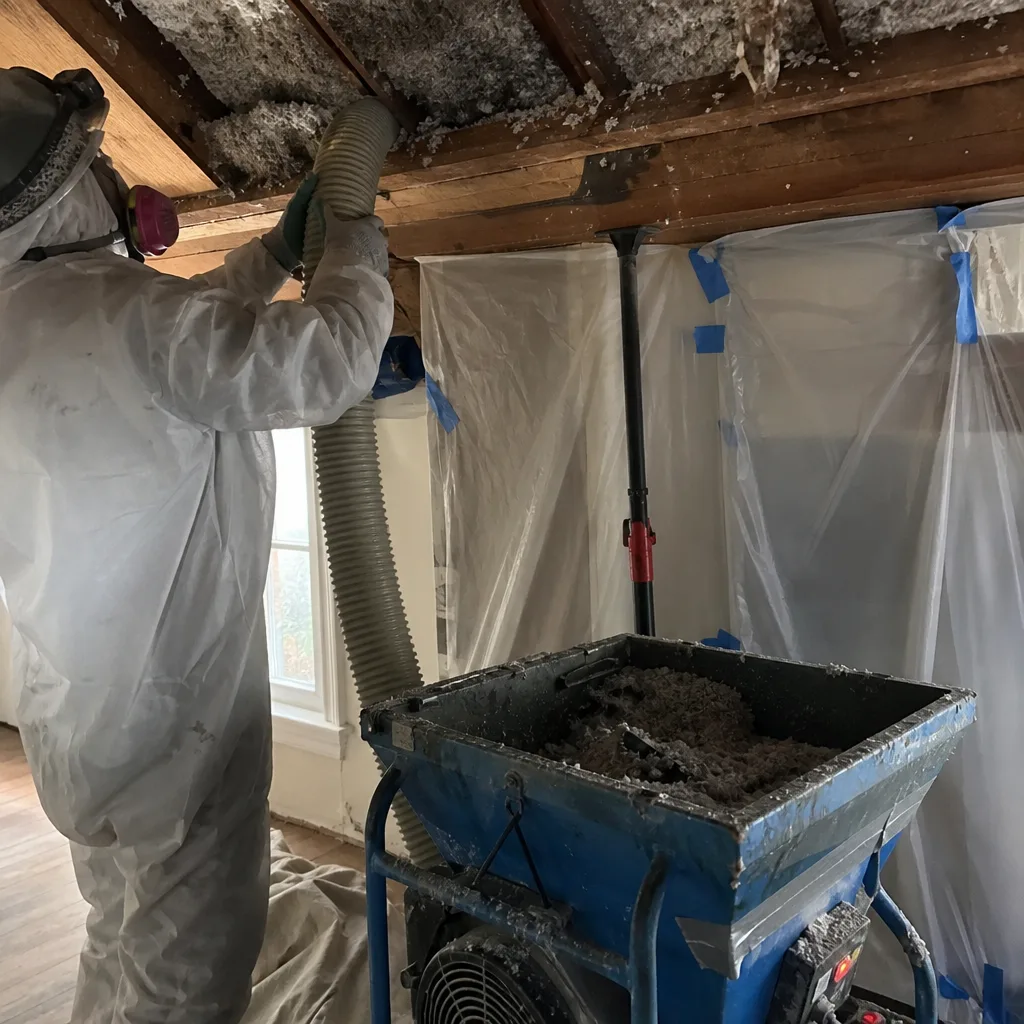
Radiant barrier is a reflective material, usually foil-faced, installed in the attic to reflect radiant heat away from the living space. Johns Manville makes several versions. It works differently from fiberglass or cellulose insulation, which slow conductive heat transfer by trapping air. Radiant barrier works by reflecting the sun’s energy before it becomes attic heat in the first place. In Ventura’s coastal climate, where summer temperatures routinely push attic spaces past 130 degrees, that reflective layer does real work. When it fails, your air conditioner picks up the tab.
Key Takeaways
- Installed cost in Ventura runs $1.85 to $3.10 per square foot, including material and labor
- We carry Johns Manville radiant barrier on the truck for same-day installation in most cases
- Foil delamination and staple pull-through are the two most common failure points we see
- Every job includes a written price before work starts and a 365-day written guarantee
- We’re an independent installer, not affiliated with Johns Manville
Which Johns Manville Models This Applies To
Johns Manville currently sells radiant barrier under a few product lines, and the naming changes over time. The most common products we install in Ventura attics are the JM reflective foil products sold as either single-sided or double-sided radiant barrier, often paired with JM’s blown-in fiberglass or JM ComfortTherm batts. Older homes in Ventura sometimes have the product labeled as Johns Manville Radiant Barrier or JM EnergyShield, which was the foil-faced polyiso insulation board with a radiant barrier facing.
Here’s what matters for compatibility: radiant barrier foil is not a precision-fit part like a furnace control board. It’s a roll material, cut to fit your joist spacing and rafter layout. What does matter is the facing type. Single-sided foil goes against the attic floor or wall cavity with the foil facing up toward the heat source. Double-sided foil can be used in cathedral ceilings and vaulted spaces where there’s an air gap on both sides. If you have the foil-faced JM rigid board, that’s a different installation entirely, and we handle that too, but the pricing differs because the board gets mechanically fastened rather than stapled.
One checkable detail before you buy anything: look at the print on the foil itself. Johns Manville prints the product name and a manufacturing code on the foil face in repeating ink marks. If the printing is gone or unreadable, measure the roll width. JM radiant barrier typically ships in 48-inch and 60-inch widths, and the 48-inch is what we see most often in Ventura ranch-style homes built in the 1960s through 1980s, where rafter spacing is 24 inches on center and the narrower roll is easier to work into those spaces.
As for OEM versus aftermarket: for radiant barrier foil, the material itself is the commodity. The difference is the substrate and the emissivity rating. JM’s product carries a low emissivity rating of 0.03 to 0.05 on the foil face, and that’s the spec that matters. A big-box roll with no emissivity rating printed on it may look identical in the aisle and perform worse in your attic. We use genuine Johns Manville product when the homeowner specifies it, and we stock quality equivalents, including Reflectix, when the job calls for it.
Signs Your Johns Manville Radiant Barrier Installation Is Failing
- Foil delamination from the substrate. The reflective foil layer separates from the kraft paper or bubble core backing. In Ventura’s coastal humidity, the adhesive layer breaks down over 10 to 15 years, and the foil starts flaking off in pieces. This is the number one failure mode we see, and once delamination starts, the reflective performance drops sharply because you’re left with a layer of paper backing pointing at the roof deck.
- Staple pull-through and sagging. The foil was stapled to the underside of rafters, and the staples have torn through the thin foil layer over time. Gravity does the rest. The barrier sags downward, closing the critical air gap between the foil and the roof deck. Radiant barrier needs at least a 3/4-inch air space on the reflective side to function. No air gap, no reflectivity.
- Discoloration and oxidation on the foil face. Foil that has been exposed to moisture or aged 15-plus years takes on a dull gray or mottled appearance instead of a bright silver finish. Oxidation raises the emissivity of the surface, meaning it absorbs more heat than it reflects. A bright, shiny JM radiant barrier reflects up to 95 percent of radiant heat. A dull one may reflect less than 70 percent, and that gap shows up as real heat gain in the attic.
- Increased upstairs or whole-house cooling costs. If your July and August cooling bills climb year over year and your attic insulation checks out, the radiant barrier is the next suspect. In Ventura, where summertime attic temperatures hit 125 to 140 degrees, a functioning radiant barrier keeps the attic 20 to 30 degrees cooler. When it stops working, your ductwork sits in hotter air, which means the air coming out of your registers is warmer before it even reaches the room.
- Signs of condensation or moisture staining on the foil. A radiant barrier can act as a vapor barrier in the wrong application. If it was installed on the attic floor over insulation in a way that trapped moisture from the living space below, you’ll see water staining, rust spots, or mold growth on the fiberglass underneath. This is less common in Ventura’s dry climate than in places like Florida, but in coastal homes near the Ventura Harbor area or along the beach side of town, morning marine layer moisture pushes into vented attics regularly.
Replacement Cost & What’s Included
Most Johns Manville radiant barrier installations in Ventura run between $1.85 and $3.10 per square foot of attic floor area, installed. A typical 1,500-square-foot attic in a Ventura ranch home lands in the $2,800 to $4,650 range. Here’s what drives the variance:
| Factor | Impact on Price |
|---|---|
| Attic access and headroom | Low-slope roofs with tight clearance add labor time |
| Existing insulation depth | Deeper blown-in insulation means more prep to expose rafter tails |
| Ductwork and plumbing obstructions | Working around duct runs adds cuts and time |
| Condition of existing barrier | Full removal of delaminated foil adds a removal charge |
| Single vs double-sided foil | Double-sided runs $0.25 to $0.45 more per square foot |
Your written price includes material, labor, tear-out of failed foil where needed, and cleanup. The number we hand you before the first tool comes off the truck is the number on the invoice. No add-ons, no “discovered this in the attic” surprise charges. Every Johns Manville radiant barrier installation we do in Ventura carries our 365-Day Done Right Promise: if the installation fails within one year, we come back and fix it at no charge.
DIY or Call Us?
Radiant barrier installation is not a high-tension danger like garage door springs or electrical work, and a careful homeowner can do this job. But there are specific ways it goes wrong in Ventura attics, and the fix is more expensive than doing it right the first time. The two real hazards: one, walking on ceiling joists in a low attic with blown-in insulation hiding your footing, and two, stapling foil over recessed light fixtures and wiring where it creates fire and electrical contact risk. Foil conducts electricity. If it drapes across a live wire or a can light, you have a problem.
What you can safely check yourself: look for the delamination and sagging described above, confirm the air gap still exists between foil and roof deck, and check that no foil is touching electrical fixtures. What we’d rather you not do is crawl into a tight attic with a staple gun, work around 130-degree heat without ventilation, or remove failed foil that’s bonded to old insulation. If you want a real answer about what your attic needs, call (341) 895-7513 and we’ll walk through it.
FAQs
In our Ventura installations, a properly installed JM radiant barrier lasts 15 to 20 years before the foil begins delaminating. Coastal homes closer to the beach tend to see slightly shorter lifespans because morning marine layer moisture accelerates adhesive breakdown. The failure we see most often in 15-year-old Ventura installs is not the foil itself but the staples pulling through, which is a $0.02 fastener problem, not a $400 material problem. Call (341) 895-7513 and we can tell you what you’re actually looking at.
In about half the Ventura attics we inspect, the repair is limited to a single section where the staple line failed or the foil delaminated, and we can cut out the bad section and install a replacement patch. Full replacement makes sense when more than a third of the foil has delaminated or when the original install was done over the attic floor rather than on the rafter bays. We’ll tell you which one you actually need, and the written price covers exactly that work.
A typical 1,500-square-foot Ventura attic installation takes one day, including tear-out of any failed material and cleanup. Larger homes, cathedral ceilings, or deep blown-in insulation that needs to be pulled back can push it to a second day. We arrive inside the scheduled window, in uniform, and we leave the attic cleaner than we found it.
We stock full rolls of JM radiant barrier as well as Reflectix on our trucks, so most Ventura jobs get done same-day or next-day without a supply house wait. We also carry JM blown-in fiberglass and JM batts on hand for jobs where you’re pairing a radiant barrier with an insulation upgrade. Call (341) 895-7513 and we’ll confirm what’s on the truck for your appointment.
Written by Bryce Holloway, Owner, Alden Insulation Ventura at Alden Insulation Ventura, serving Ventura and nearby areas.